Sunday, June 9, 2013

Great Basin Institute Internship Wk 2 & 3

Hi again,

Since I wasn't able to make a post for week 2 I will be combining both into this post.

Week 2

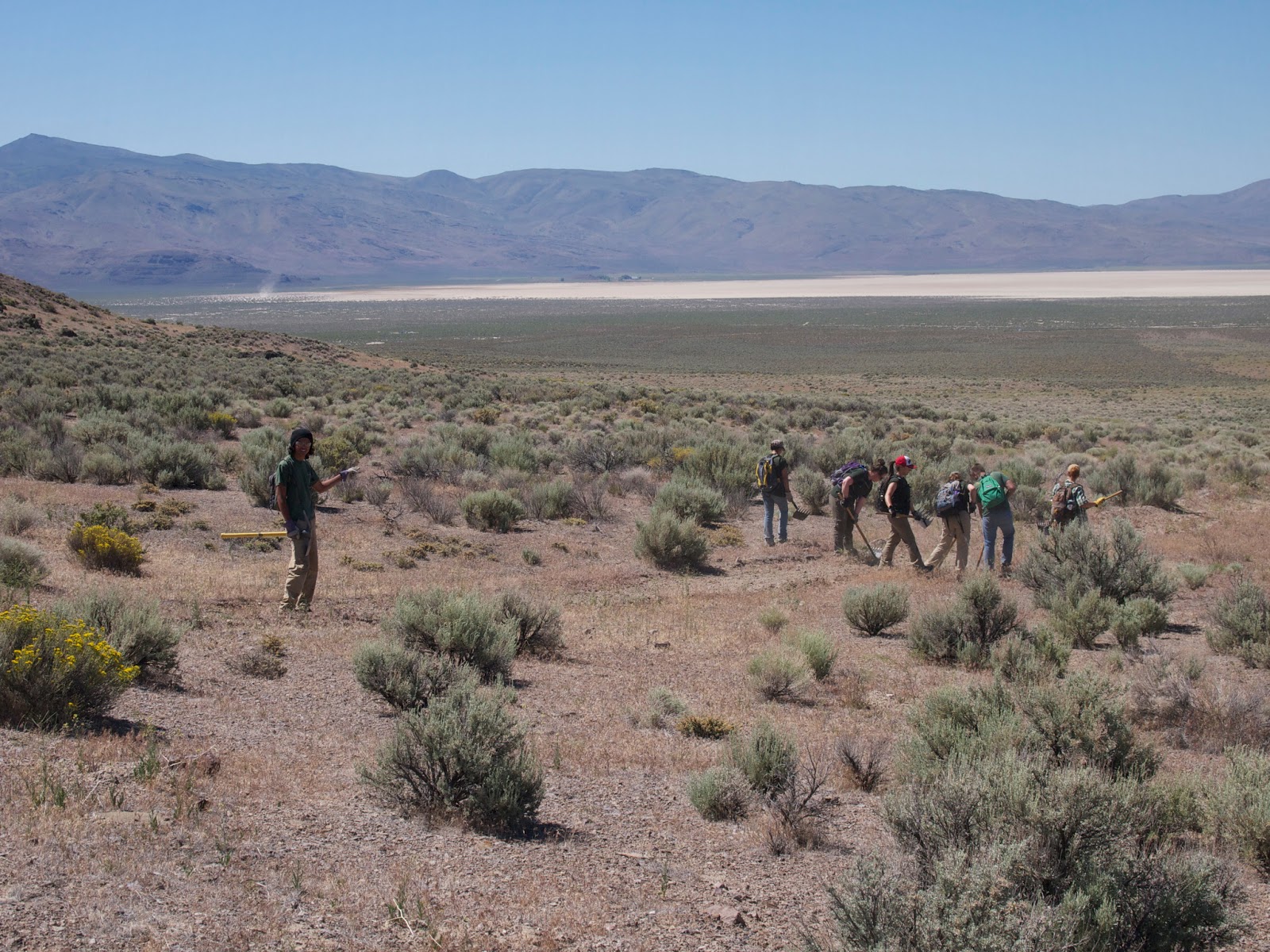
This week I continued my work on the dirt bike and ATV trails in Dry Valley. Our group was able to finish the main sections which included trails 11, 14, 15, 16, and 17 adding to more than 10 miles of trail. We were moved to another section of trail to work on the harder black diamond trails. This work involved a lot more rock work and the temperatures started to climb making water my new best friend! The Bureau of Land Management has been really impressed with the work being done because there is a race in the valley every year. Also from what I understand, maintaining trails can cost a fortune. Using a Sweco trail machine can cost up to $1,000 per mile which can really hurt their budget. I've been really happy to work for them, and have met a lot of great people working in the business.

I had a shorter weekend due to Memorial day, but I was able to make it up to Lake Tahoe which was quite an experience and the water was freezing! The views are unmatched as being surrounded by Pinus ponderosa and snow capped mountains. The weekend went by really quickly and it was on to week 3.

Week 3

We moved on to another section of the mountain and continued doing rock work. A lot of the trails on this portion where covered by rocks and it is important that the trails are detailed to ensure the safety of use. Temperatures have reached the 100's this week and working in the valleys can be brutal if not prepared. There is very little air flow and energy can be used up quickly. I think the group did a great job this week and we cleared a large amount of trails. Since this was the last week in Dry Valley and the work left was minimal, our supervisor used our last couple of hours to show us some native drawing that have been there for so many years. It was definitely an added plus to the week, and then to finish it off we climbed in a cave that holds one of the only permanent source of water. We also ended extremely hot our days with a swim in Pyramid Lake which is an Indian Reservation.

I spent this weekend watching the Reno Aces baseball game, exploring more of downtown, and going back to Lake Tahoe for the whole of Saturday. Today, we are planning a trip to float down the Truckee River.

Next week I start working on noxious weed removal around the Lake Tahoe.

Thinking about Yosemite next weekend!!


Enjoy,

Craig


Sunday, June 2, 2013

Great Basin Institute Internship Wk1

Hello All,

Sorry this post is coming a little late. There hasn't been much access to the internet the past two week but its finally is up an running.

I arrived in Reno, Nevada on Monday the 20th to start my internship. At 8am we took a 4 hour Weed Warrior course which introduced me to many of the invasive and noxious weeds that can be found within Nevada and how to control them. The next day we complete another 4 hours of Weed Warrior training where I earned a certificate. Then it was off to work.

My internship involves various different jobs over the course of six weeks. The first 3 weeks will be recreational trail work and the last 3 weeks will involve spraying and removing invasive and noxious weeds.

The Great Basin Institute (GBI) has partnered with the Bureau of Land Management in Eagle Lake, California. We drove 2 hours north of Reno to Dry Valley to camp out for 4 days. Here we are spending 3 weeks focusing on dirt bike trails and ATV trails.


The tools we have been using are the McCloud, Shovel, and Pick-Matic. The first week our group clear around 2 miles of trail and created an new trail which created a shortcut between two trails. Dry Valley is extremel barren but host an awesome amount of wildlife. We have seen pronghorn, mule deer, wild horses, coyote, and fox. I will attempt to get a map of the area as soon as possible.

During the weekend, GBI hosted all the groups this summer to attend a weekend trip to Mammoth. This was a great experience as I got to visit Devil's Post Pile, various hot springs, and an old abandoned  mining town called Bodie. There was also a blonde bear walking through our campsite in Mammoth!

I have many more pictures but have been having an issue with my camera. They will be posted as soon as I figure out the problem. I will be heading back to work where I'll camp out for 4 days. More posts are soon to follow.

Talk soon,

Craig

Tuesday, May 14, 2013

2013 MAPACA Jubilee


04.26.2013

2013 MAPACA Jubilee


Northern Solstice Alpaca Farm in Unity, Maine is home to 28 Huacaya (pronounced wuh-kai-ya) alpacas. Owners Robin Fowler and Corry Pratt founded their farm in 2004 and bought their first alpacas in 2006. Then in 2009 they started the Alpaca Center of New England, "an organization providing educational opportunities for all alpaca owners and anyone interested in learning more" [1]. Alpacas are a domesticated species of camelid that hail from South America. They are raised primarily for their luxurious fiber and were first imported to the United States in the 1980's.

This internship was not my first time working with alpacas. I had cared for the alternative species at Alfred State College's Farm Laboratory, which included five male Huacaya alpacas, for three semesters. Additionally, during my senior year at Alfred State College I had served as a Supplemental Instructor for a Farm Animal Management class that included a unit on alpacas and llamas. This internship appealed to me because I had a strong desire to learn more about raising alpacas in a sustainable fashion, and the owners of this farm are highly respected in the industry.


3 AM comes early when you're too excited to sleep. I'd done evening chores at the farm the night before and was eager to attend the 2013 MAPACA Jubilee in my home state of Pennsylvania. The car was mostly packed, except for my Husky and myself. I drove to Northern Solstice a little before 4 AM to help them load the five girls, and was impressed at how easily the young ladies stepped into the dark trailer. The sun was still hiding and it was raining but everyone was in good spirits. Then we hit the road for an uneventful 10 hour drive. Once we reached Pennsylvania, I left the trailer behind to drop my dog off at the farm where I had grown up. This was to be the first Level 5 alpaca show that I had ever attended.


After dropping my dog off, I headed to the Pennsylvania Farm Show Complex and Expo Center in Harrisburg. Corry and Robin had already checked the girls in, so I assisted them with setting up their booth. This included moving panels, hanging containers for hay and water, and carrying in the farm display and banners. At check in, volunteers enter each alpaca into a color class by comparing the animal's fiber to a color chart. Three of the alpacas we brought needed to be evaluated by the judges at 8 PM because the volunteers could not agree on the color. So at 8 PM we brought Emma, Riata and Sweet P to the judges in Arena #2 to be color checked. This second check is important because an alpaca can be disqualified for being in the wrong color class. Robin and Corry explained that if an alpaca's color is questionable  it is best to be placed in the darker color class as it will show a brighter fleece. The owners are not allowed to interact with the judges, so I was assigned the task of bringing the ladies to be evaluated.


The next day I arrived at the Farm Show Complex at 7:30 AM to clean the pen so the alpacas would not soil their fiber. The pens at this show have real turf as a substrate, which absorbs urine and is easier to clean than a rubber mat. Huacayas must be shown in a natural state, so we had to carefully pick the hay and straw out of their fiber with our hands, which is another reason the turf is preferred over bedding such as straw or shavings. One concern of using turf is that the alpacas might eat too much of the rich green grass and have loose manure. Northern Solstice prides themselves on the superior health of their animals, so I observed that their alpacas were not nearly as effected by the green grass and stress as other animals at the show. I also filled the water buckets, and as is fairly standard of any livestock show, we had brought water from the farm to avoid the possibility of the animals refusing to drink unfamiliar water.

Riata was to be shown in the second class of the day, and Corry arrived dressed in a black and white suit as is proper professional attire for the show ring. Riata ended up placing fourth in a class of six. At an alpaca show, the animals are grouped into classes by breed, age, gender, and color. They are lead into the arena one at a time so the judge can evaluate fiber characteristics and conformation. The judge watches the animal walk towards her, then away from her, then from the side. The animals line up side-by-side in the arena. There is usually no more than 12 in a class, so a larger class may be split into two groups. Once all the alpacas are in the arena, the judge inspects each individual animal. This includes parting the lips to ensure that the alpaca's upper dental pad and lower incisors meet correctly. The judge then works from head to hip and inspects the fleece for fineness, density, consistency and character. Finally the judge checks the genitalia by lifting the tail. Only a maximum of six alpacas will be placed, so the judge selects her top six alpacas and ribbons are awarded. The judge then gives oral reasons for why she placed the class the way she did.


The next alpacas to be shown were Savanna and Sweat P. These classes were back to back, so I checked in Sweat P and held her in line, called the "deck," while Corry showed Savanna. At this particular show, there is a first deck and second deck where you wait with your class to go into the arena. This helps to ensure that the show runs smoothly and in a timely fashion. Both of the girls were quiet in the ring and placed second and fifth respectively, which was a wonderful testament to Northern Solstice's breeding practices and the genetic prowess of their herd sire, AG Space Cowboy. Because Savanna placed second, she had to return for the selection of Champion and Reserve Champion of all females of her color, and I was tasked with haltering her and bringing her back to the arena for Corry to show. In this Champion class, the first place females from all age groups of that color are lined up for consideration, and the second place females are lined up behind them. When the judge selects a Champion, the second place female behind that animal will step up into the first line for consideration. The judge then selects her Reserve Champion.


04.28.2013

The show ran until Sunday. All of the alpacas we brought ended up "placing in the ribbons" in their classes. It was a wonderful experience for me and solidified my decision to have alpacas in the future. I was able to successfully select the first place alpaca in each class that I observed so my eye for desirable characteristics is certainly improving. Also, out of all the livestock species that I have shown, this was the least stressful show atmosphere that I have ever experienced. It was a wonderful networking opportunity as well.

Tuesday, September 11, 2012

The 2012 summer internship season has just about wrapped up. Supervisor evaluation have been sent out and are steadily being returned. Interns are working on learning objective reflection papers and compiling their portfolios. Many students will be presenting their experiences to public audiences around campus. One really nice touch is when students send a formal thank you letter to site supervisors. This is a great way to express gratitude and to keep a line of communication open. While most of our students complete internship during the summer, we do have a few that find meaningful experiences in the Unity area. Please feel free to stop by the CRC for more information on internships. Nicole

Tuesday, August 7, 2012

Week 6 at Harbor Family Services

This week for some reason everyone had either really good days, or just really bad days.  For a few the good days are nothing new, they have been that way the whole time, although since its week 1 of what could be a long stay, this is probably just what seems to be called, "the grace period".  apparently, and this seems to be true, the first few weeks a resident is there, they always seem to be extremely well behaved, always doing what they need to do, and whatever is asked of them.  But than something always sends them off the deep end and you finally get to see why they got there.  Every resident has something that has happened to them, or some actions they have done to get them in long term residential care, and they never seem to go away overnight.  When you get sent on such a severe treatment plan, there is something there that takes time and alot of effort to fix.
   Running away seems to be the thing this week.  2 of the residents ran away 3 times this week, always going together.  Each time it was always 1 resident convincing the other to go.  There was some positive news though, we were able to convice the 2nd resident not to run the 4th time, he sat there begging the 1st not to run.  This seems to have set in though because only a few minutes after he ran, he walked back through the door, on his own free will, no need for law enforcement to intervene.  The policy here is if they run, call the director and let him know, maybe try a little bit, and than call law enforcement, who will find them and bring them back.  But we arent supposed to chase them down or really go look.  Occasionally a staff member will see them walking down the street and follow them till the police can arrive, but the police always bring them back if they run away.

Wednesday, July 25, 2012

National Aviary - Past Two Weeks

Things have been extremely busy here at the aviary. Summer camps are in full gear, and there's plenty of newly fledged chicks up and about as well. I have now worked on all three of the routines offered to the interns. Currently I am working within the Tropical forest exhibits and have been settling into the routine quite nicely. After a few more days I should have it down no problem, and won't need to constantly check in with Diane or Jaime my trainer supervisors. Downside to the routine...I hate fire ants and there are plenty on this routine.

Over in the wetland exhibit we have been helping Dave tackle an algae problem by force. The pond is being drained once a week and pressure washed/hosed down (believe it or not, a whole day worth of work). With some extra hands we have been picking the algae up by hand and scrubbing it off with brushes where the hose can't seem to blast it off. Little by little over the past two weeks we have been hitting different sections and completely detail cleaning them. If we keep it up and manage to get the algae under control, future maintenance should no longer be such a huge issue for us.Which in return, saves us time and perhaps even some money.

As far as my training projects go, I have been making great progress in some, and very little in others. Joni and Squiggie are getting the hang of my stationing training. Squiggie seems to be picking it all up much faster than Joni, but once they see one or the other listening to me, they will jump right on the band wagon immediately. Along with those two, I've spent loads of time working to get the Flamingos re-conditioned for the flamingo encounters. I have been timing my sessions and dressing like guests to help them adjust to presence in their territory. It is also my hope to relieve some of their aggression towards people in general especially since it is their breeding season and they have been making work difficult for our trainers and interns. It has been working seemingly well for the past two weeks and the length of the sessions has nearly double since I have started. The only downfall is that they are constantly attempting to nest in high traffic areas, where myself and all the trainers must work. This creates new aggression between the flamingos and our staff and does appear to be holding us back a great deal. Training outside of breeding season may work more efficiently however these birds can have a wide range of timing given their habitat conditions. Here at the aviary we can mimic rain almost every day, and food is available to them with no shortage. Those two things are key to their natural breeding habits, and in the wild, the breeding season generally mimics those conditions and can last the entire time those needs are met for the most part. Regaining our ability to have flamingo encounters offers far too much to the aviary to just drop or let go however.

My time spent here will be wrapping up in the next few weeks, and I've been working on networking with some of the co-workers here. Perhaps in the future I could seek advice from them, or ask for references. I'm definitely looking forward to a busy time until I leave for Unity, and it's time to soak in every last drop of knowledge I can find here. 

Sunday, July 15, 2012

Week 5 at harbor family services

Not alot out of the ordinary this week, although I guess what is ordinary here can be pretty unique.  The heat seemed to bring out the tempers in a few residents, with the smallest seeming to have the worst.  It's hard to see the tempers coming sometimes, but there is a system of accountability for their actions that is built into the program that quite often gives an easy way to remind them there are better ways of dealing with stress.  Each resident has a sheet for each day that keeps track of how well they followed the rules.  Each day if they don't follow the rules, which could include not cleaning their room or doing chores, or acting out and not following staff directions, points are deducted.  This point system is used to determine what type of activities they are allowed to do.  There are 3 levels, level 1 meaning that they stay on grounds and have not been doing what is expected of them at all.  This could also mean they will be confined to their room for the majority of the day.  to get off level one they have to keep a minimum number of points for a week.  Level 2 means that they are following a majority of the rules, and after a few days on level 2 are allowed to do things like go hiking, swimming, visit the library.  There is alot more freedom with this, which at first some residents take as a chance to act out, such as running away, swearing, threatening violence.  If these actions happen they are first dropped down to the first day on level 2, and than if they continue they are dropped down to level 1.  Level 3 is the highest level and there is a great amount of freedom involved.  They are allowed in the kitchen occasionally, and don't have to go up to their room for quiet time if they don't want to.  If they are old enough they may also be allowed to play rated M games on one of the game systems in the house.  There is actually a level called OLS (off level system).  Although every resident is on the level system, the title seems to have a bit of honor on it among residents, but they standards are pretty high, as these kids are expected to be able to set an example for the rest of the residents.  There is a 3 ring binder where all this is kept track off, along with there individual treatment goals.  The activities required to rise in the level system are stressed as things that are expected of everyone in society, but there is a little room for human error.  No one is expected to be perfect, since no one really is.  Bad days are expected, and although they may drop down to the beginning of their level, they are shown better ways to deal with those bad days so that they won't drop next time.